
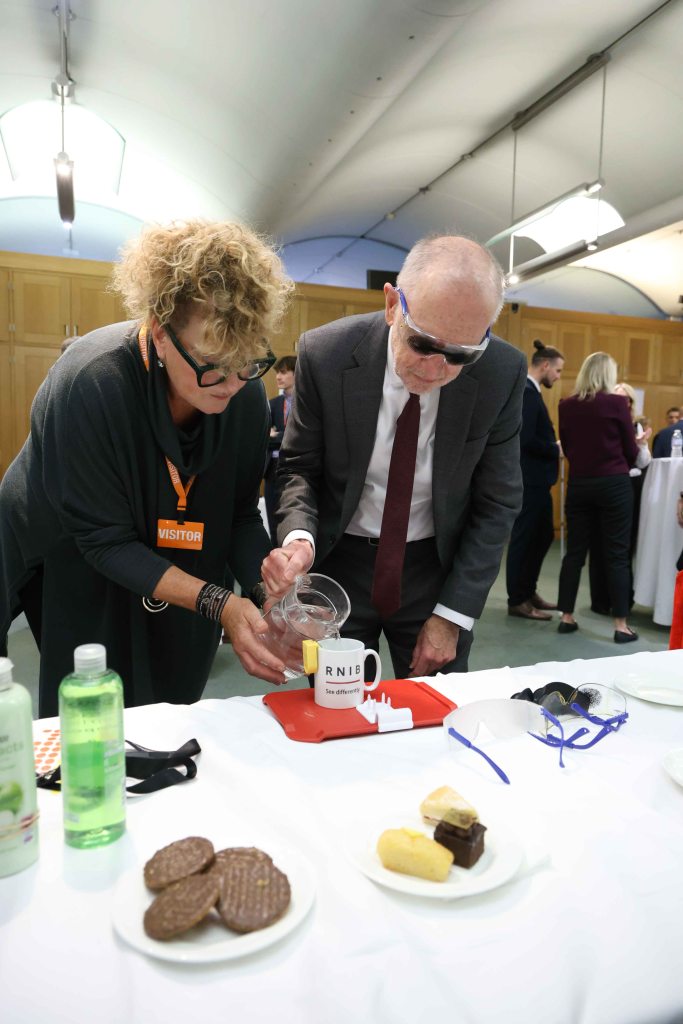
Paul attended a parliamentary drop-in event organised by the Royal National Institute of Blind People (RNIB), on Monday 17 November at the House of Commons, to back the charity’s call for an end to unacceptable wait times for essential support after people are diagnosed with a sight condition.
At the event, he met blind and partially sighted people, professional Vision Rehabilitation Specialists, and RNIB staff and ambassadors to find out about the difference that timely access to local authority support – known as vision rehabilitation, can make, and learn more about this vital but often overlooked part of social care that enables blind and partially sighted people to live safely and independently after sight loss.
New research by RNIB shows that the vision rehabilitation support provided by local authorities including essential white-cane training, cooking and technology skills, has become an under-funded Cinderella social care service across England.
RNIB’s recent Freedom of Information report shows that across England, 20 per cent of local authorities (17 authorities) had people waiting over a year to receive just an initial assessment of the services they need; 85 per cent of local authorities did not complete vision rehabilitation assessments within the RNIB-recommended 28 days and 38 local authorities told us assessments are not always conducted by qualified Vision Rehabilitation Specialists.
At the drop in, MPs had the chance to try out some of the tools and adaptations blind and partially sighted people use to navigate the home, workplace and outdoors, hear directly from people whose lives have been transformed by vision rehabilitation, meet the specialists who deliver these services and find out what they can do to speed up access to support.
Paul is now encouraging people to sign RNIB’s petition, calling on the Health Secretary to ensure vision rehabilitation is effectively and consistently delivered for people with sight loss.
Paul Davies MP said: “Meeting blind and partially sighted people who have benefitted from vision rehabilitation made it crystal clear to me that this service is vital in supporting my constituents with sight loss to thrive and regain independence, whether that be navigating public transport, cooking a meal, or returning to the workplace. Vision rehabilitation restores confidence, independence, and the ability to take part in everyday life. It’s also very clear that it’s an under-resourced and unregulated service across England. We can’t let this continue. I’m calling on Wes Streeting, Secretary of State for Health and Social Care, to commit to ensuring blind and partially sighted people get the emotional and practical support they need, when they need it most.”
RNIB Chief Executive Officer Matt Stringer said: “Too many people feel that their life is on pause while they wait for the services they are entitled to. But with the right support and equipment people can live confidently and independently. Losing your sight doesn’t mean you have to stop doing what you love. We’re grateful to xx MP for joining us today to add weight to our call for action.”
ENDS
About Vision Rehabilitation
Effective vision rehabilitation is achieved by providing a package of
services, including:
▪ mobility or white cane training
▪ emotional or peer support
▪ technology training to use phone accessibility features or screen reading software
▪ support to complete daily tasks, such as cooking.
Each person is assessed on their individual needs and receives a tailored package of support to meet the desired outcomes.
RNIB’s four steps for change:
1. Commission the National Institute for Health and Care Excellence (NICE) to develop guidelines and quality standards for vision rehabilitation.
2. Subject vision rehabilitation services to the same regulation and
monitoring as other adult social care services. This could be done within the current legislative framework and by extending the remit of the Care Quality Commission.
3. Recognise the skill and expertise of Vision Rehabilitation Specialists (and Qualified Habilitation Specialists) by making Vision Rehabilitation Specialists a regulated profession.
4. Encourage better integration of services, by strengthening the links between secondary and social care settings, with a guaranteed route into vision rehabilitation for everyone who needs it, while ensuring blind and partially sighted people are informed of their rights and the services they can expect to receive.
About RNIB
We are the Royal National Institute of Blind People (RNIB).
Every six minutes, someone in the UK begins to lose their sight. RNIB is taking a stand against exclusion, inequality and isolation to create a world without barriers where people with sight loss can lead full lives. A different world where society values blind and partially sighted people not for the disabilities they’ve overcome, but for the people they are.
RNIB. See differently.
Call the RNIB Helpline on 0303 123 9999 or visit www.rnib.org.uk
 Paul Davies MP