
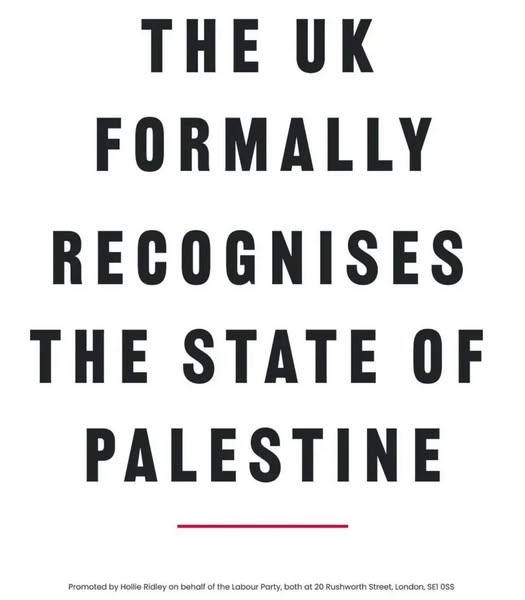
In a historic and morally significant move, the United Kingdom has officially recognised the State of Palestine. This decision, taken in concert with key international allies, marks a pivotal moment in our enduring commitment to a two-state solution—one that envisions a safe and secure Israel alongside a viable and sovereign Palestinian state. It is a reaffirmation of the inalienable right of the Palestinian people to self-determination and a fulfilment of our manifesto pledge.
The urgency of this recognition stems from the deteriorating situation in the Middle East. Since the Prime Minister’s pledge in July, the humanitarian crisis in Gaza has deepened, illegal settlements in the West Bank have expanded, and hostages remain in captivity under Hamas. These developments have placed the prospect of peace under unprecedented threat. Recognition is not a reward for Hamas, a terrorist organisation whose vision is antithetical to peaceful coexistence. Our demands remain firm: Hamas must release all hostages, agree to an immediate ceasefire, renounce governance in Gaza, and commit to disarmament.
This decision is rooted in the belief that both Israelis and Palestinians deserve to live free from violence and suffering. For decades, British governments have advocated for a two-state solution but recognised only one state. Today, we correct that imbalance. Recognition of Palestine reflects the equal rights and dignity of both peoples and sends a clear message that peace is possible.
The Prime Minister has met with families of British-linked hostages and has witnessed their anguish. Their plight remains central to our efforts. We continue to support every initiative aimed at securing their release and ending the violence. The UK has already evacuated injured children from Gaza for treatment and is increasing humanitarian aid, though much more is needed. We call on the Israeli government to lift border restrictions and allow aid to flow freely.
Recognition alone is not enough. That is why we are actively building regional and international consensus around our Framework for Peace—a practical plan that includes reforming the Palestinian Authority and progressing from ceasefire to negotiations. This framework is essential to reviving the hope of a durable peace.
The Foreign Secretary has emphasised that recognition is a vital step to preserve the two-state solution and will be central to diplomatic efforts at the UN. The UK recognises Palestinian statehood over provisional borders based on 1967 lines, with land swaps to be finalised through future negotiations. Full diplomatic relations will be established in due course.
This decision has already catalysed a significant shift in the Arab world, with all 22 members of the Arab League signing a declaration rejecting Hamas and calling for peace. It is a moment of clarity and resolve.
We must now unite against hatred and division, and channel our collective efforts toward a peaceful future. Recognition of Palestine is a step toward that future—a future where Israelis and Palestinians live side by side, in peace, with dignity and security.
 Paul Davies MP